

Cybersecurity has become inseparable from business continuity. Every connected system creates opportunity, but it can also expose operations, customer records and intellectual property. Attack methods develop rapidly, exploiting exposed services, stolen credentials and ordinary moments of human hesitation. Business email compromise exploits trust, while one cyber attack can interrupt revenue and damage hard-earned confidence.
For UK businesses, discussing protection before an incident is essential, not alarmist. The top cybersecurity companies help organisations handle cyber threats. That begins with understanding exposure and reducing risk without obstructing daily work. This article examines the safeguards. It also considers the providers and their costs, offering the context needed to make informed cybersecurity and data protection decisions.
What to Consider When Selecting a Cybersecurity Provider
Choosing a security partner requires more than comparing product names. Begin with your organisation’s size, systems and regulatory duties, then define the exposure that must be reduced. A credible provider should explain its approach plainly, demonstrate relevant operational experience and also fit the way your people work.
Test whether services strengthen your cybersecurity posture rather than adding disconnected tools. Quoted price matters, but dependable support and accountable ownership matter equally. In a crowded provider market, careful evaluation separates practical protection from impressive claims that deliver little control when pressure rises.
- Reviews and Industry Recommendations: Independent feedback reveals how a provider performs after implementation, not merely during sales. Look for relevant case studies, analyst recognition and recommendations from security leaders. Evidence within the cybersecurity industry should show consistent outcomes for organisations with needs resembling yours.
- Security Services and Coverage: Protection should reach every exposure point, including users, devices and hosted workloads. Confirm that the proposed range of cybersecurity capabilities suits your environment. Connected security layers reduce blind spots, while clearly defined boundaries prevent important systems from being assumed covered.
- Certifications and Compliance Expertise: Recognised credentials matter. ISO 27001 demonstrates management. Cyber Essentials confirms baseline protection, while CREST supports confidence in specialist testing. Certificates are only the start. Information security expertise should interpret GDPR and sector obligations, producing controls with evidence and repeatable processes.
- Threat Detection and Incident Response: Attackers do not follow office hours. Continuous monitoring matters. Ask who verifies each alert and how containment begins. Recovery needs an owner too. Effective threat detection and response combines technology with judgement, creating a clear route from suspicion to action.
- Service Level Agreements (SLAs): An SLA should make expectations concrete. Read the availability commitment. Then check the promised response time. Escalation must have a clear owner, especially during an incident. Dedicated security support needs precise boundaries. Measurable priorities give urgent events prompt attention consistently.
- Scalability and Future Growth: Today’s arrangement must support tomorrow’s organisation. Headcount may rise. New locations and applications could follow without forcing a redesign. Licensing should remain flexible. Integrations must stay workable. Providers serving companies in 2026 should absorb growth while preserving control and visibility.
- Reporting and Security Visibility: Reporting should explain what changed and why it matters. Raw alerts are insufficient. Ask for dashboards suited to the audience, supported by scheduled reviews. Strong security analytics reveals unresolved exposures and tracks control performance, giving leaders grounds for investment decisions.

Main Pillars of Cybersecurity
Effective protection is built across several connected domains, as Check Point frameworks also illustrate. Each addresses a different route through which systems, identities or information may be compromised. Treated separately, gaps remain. Brought together as one cybersecurity stack, they create defence in depth and give teams clearer oversight.
The right balance depends on how an organisation stores data, supports users and delivers services. Understanding these pillars helps buyers compare security solutions properly, identify missing security tools and direct investment towards the cyber threats most capable of disrupting essential business activity.
- Cloud Security: Controls must follow workloads and information beyond the traditional office perimeter. Well-designed cloud services apply secure configuration, workload monitoring and access policies across public, private or hybrid environments, reducing exposure while allowing teams to scale resources and release applications confidently.
- Network Security: Traffic inspection and segmentation prevent malicious connections from moving freely through infrastructure. A modern firewall enforces policy at key boundaries, while encrypted traffic analysis and continuous monitoring expose suspicious behaviour. The aim is controlled connectivity without creating unnecessary operational friction.
- Endpoint Security: Laptops, mobiles and servers need protection wherever people work. Extended detection and response correlates activity across devices and other sources, helping analysts recognise linked behaviour earlier. Isolation and remediation capabilities can then contain compromise before it spreads into wider systems.
- Data Security: Records require classification, encryption and retention controls throughout their lifecycle. Access should reflect genuine business need, with changes logged and recoverable copies maintained. This approach supports privacy obligations while limiting what an intruder can view, alter or remove after entry.
- Email Security: Filtering must assess links, attachments and sender behaviour before harmful messages reach employees. Authentication controls reduce impersonation, while gateways examine inbound and outbound traffic. Because inboxes remain a favoured route for fraud, layered screening should sit beside informed user judgement.
- AI Security: Artificial intelligence can accelerate analysis, but models and inputs also need protection. Governance should control approved use, sensitive prompts and automated decisions. Used thoughtfully, adaptive detection can identify emerging threats faster while human oversight checks context, accuracy and proportionate intervention.
- Identity and Access Management: Requests should be verified according to identity, device and context. Zero trust principles restrict unnecessary access, while multifactor authentication strengthens login assurance. Tight controls over privileged access reduce the damage possible through stolen credentials or excessive permissions inside sensitive environments.
The Top 10 Best Cyber Security Companies and Providers
Digital defence is a continuous contest, not a project completed once. The top cybersecurity companies in 2026 stand on the front lines for clients, watching changing tactics and improving controls before weaknesses become crises. Their role is broader than blocking attacks. Strong cybersecurity combines prevention with rapid detection, informed response and recovery planning, helping organisations protect data while maintaining essential services under pressure. As we explore the top options, capabilities vary: some build platforms, whereas others manage the whole environment.
1. Cloud Central
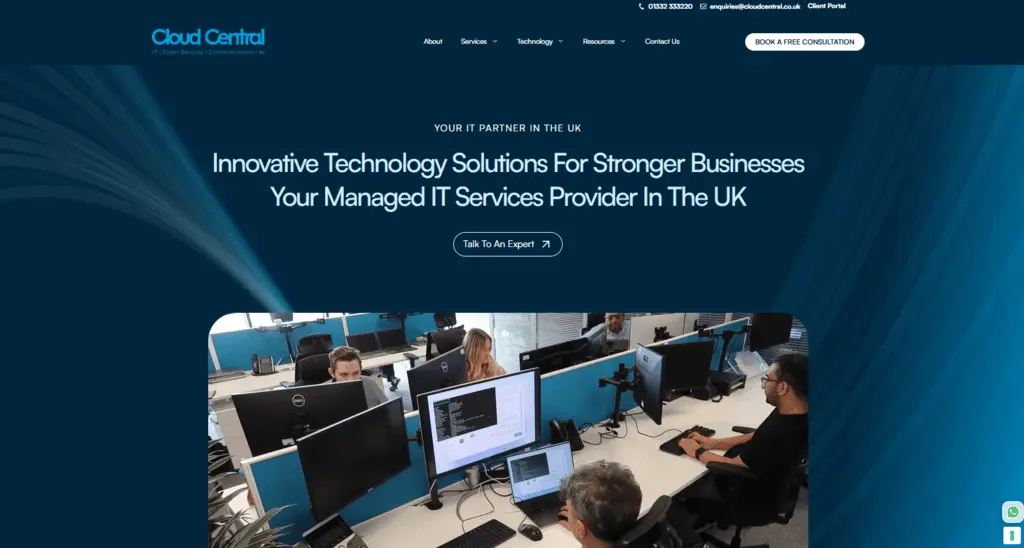
Website: cloudcentral.co.uk
Cloud Central is our top choice among reviewed providers because it combines tailored advice with day-to-day protection for UK organisations. Its cybersecurity solutions cover networks, endpoints and email, supported by monitoring that keeps emerging exposure visible. Rather than forcing a standard package, specialists assess the environment and shape managed security services around genuine operational needs. That approach strengthens cyber resilience while preserving clarity over ownership, compliance and response. Clients also gain broader managed services expertise, making Cloud Central a practical long-term partner for secure digital transformation and accountable security management.
2. Fortinet
Website: fortinet.com
Fortinet secures distributed estates through its Security Fabric. Networking and protection sit within a connected architecture. FortiGate appliances handle high-performance inspection. FortiGuard Labs feeds current threat intelligence into integrated controls, keeping enforcement informed as conditions change. The reach is broad. Branches are covered, alongside data centres and remote access. Depth brings complexity, however. Before adopting such a wide product set, buyers should confirm whether internal expertise is sufficient or partner support will be needed across complex hybrid environments at scale.
3. Cloudflare

Website: cloudflare.com
Cloudflare uses its global edge network to stop threats before they reach services. DDoS mitigation blocks high-volume attacks. Web application protection adds another barrier. The cybersecurity platform manages secure access near each user. Cloudflare One extends this model, providing a security platform for identity-aware connections to private applications. This makes the provider compelling for internet-facing estates and distributed workforces. Organisations needing deep endpoint coverage may still combine it with other specialist providers, creating broader defence across internal systems and devices.
4. Darktrace
Website: darktrace.com
Darktrace applies behavioural models to understand normal activity across digital environments. It then highlights deviations and can take targeted autonomous action during incidents. Interest in companies like Darktrace reflects the value of adaptive analysis when known signatures cannot describe a new technique. Its award-winning cybersecurity approach can surface subtle anomalies, although expert review remains necessary to tune outcomes and investigate context. It works particularly well as an intelligent layer within a wider architecture, rather than an unquestioned replacement for analysts.
5. IBM
Website: ibm.com
IBM brings long-standing enterprise security expertise through software, consulting and research. IBM QRadar supports centralised event analysis and investigation, while IBM X-Force contributes global cybersecurity insight drawn from research. This combination is particularly suited to regulated organisations that require structured governance across complex hybrid estates. IBM supports strategic policy and incident preparation alongside technology. However, its breadth may bring higher cost and implementation effort. Buyers should define their protection priorities clearly, ensuring the chosen capabilities address exposure instead of adding avoidable complexity.
6. Microsoft
Website: microsoft.com
Microsoft protects Microsoft 365, Azure and Windows through Defender, Sentinel, Entra and Purview. Defender provides XDR across endpoints, identities and applications, while Sentinel brings cloud-native event management and automation. This connected approach is attractive where Microsoft technology already dominates the estate. It can improve visibility without introducing a separate ecosystem. Licensing and configuration still require care, particularly for organisations with mixed platforms. Effective deployment depends on clear policies, skilled administration and a precise understanding of which features each subscription includes.
7. Cisco

Website: cisco.com
Cisco combines deep, established networking experience with Duo, Talos and cross-domain response capabilities. The portfolio correlates signals across environments, helping security teams investigate activity through stronger shared operational context. Talos research adds intelligence, while Duo strengthens identity verification. The model can be especially effective for organisations already invested in Cisco infrastructure. A broad catalogue may nevertheless require thoughtful architecture. Selecting only relevant components, then integrating them properly, is essential if buyers want control rather than another collection of overlapping consoles.
8. Palo Alto

Website: paloaltonetworks.co.uk
Palo Alto Networks spans network defence, sophisticated cloud workloads and security operations through Strata, Cortex and cloud capabilities. Cortex combines data with automated analytics, supporting faster investigation across complex estates. The range appeals to large organisations seeking platform consolidation and mature exposure management. It also supports an identity-led approach through access and policy controls. Implementation can be demanding, however. Strong design and governance are needed to turn the portfolio’s depth into measurable outcomes, rather than expanding licences and administrative overhead.
9. Softcat

Website: softcat.com
Softcat brings UK-focused consultancy, procurement and services across people, networks, platforms and data. Unlike cybersecurity vendors centred on one product family, it can evaluate technologies from multiple partners and assemble carefully balanced safeguards. That practical flexibility suits organisations seeking guidance through a crowded field, including public-sector buyers and growing businesses. Softcat also supports cloud projects and assurance work. Results depend on a well-defined scope, so customers should establish responsibilities, service boundaries and success measures before choosing an ongoing support arrangement.
10. CrowdStrike
Website: crowdstrike.com
CrowdStrike’s Falcon architecture delivers cloud-native protection across endpoints, identity and workloads through a lightweight agent and shared intelligence. Falcon OverWatch adds expert threat hunting, helping uncover activity that automated controls may miss. The provider is widely associated with leading cybersecurity capability in endpoint defence and managed detection and response. It is well suited to organisations prioritising deployment and detailed adversary visibility. Broader requirements still need planning, particularly where network controls or existing tools must integrate cleanly with the Falcon environment.

How much are UK cyber security companies charging in 2026?
Pricing among cyber security firms in the 2026 cyber security market follows per-user or per-endpoint subscriptions, with separate project fees for certification, testing and remediation. Charges cover licensing and monitoring hours. Analyst involvement adds cost, as do tighter response commitments and a complex estate.
Simple security software costs less than round-the-clock managed services because human investigation changes both value and delivery. Scope matters as much as headcount. Below are realistic UK ranges for common requirements, helping buyers compare proposals and understand what each level of protection covers before committing budget.
Cyber Essentials & Cyber Essentials Plus
Certification costs depend on organisation size, assessment route and readiness. A straightforward self-assessment carries an IASME fee, whereas guided options include IT consultancy and may cover corrective work. Plus certification adds independent technical verification, so device numbers matter. These routes establish baseline controls and can support tenders, supply-chain assurance or insurance requirements. They do not replace protection, but they create a useful foundation. Budget for remediation separately when old software, weak configuration or inconsistent access controls would prevent a successful assessment.
- Cyber Essentials (self-assessment): IASME charges £300 for the 1–9 staff micro band, rising to £500 for the regulated micro band. Consultancy is additional if external guidance is used. This route suits organisations able to examine controls honestly and complete all required improvements independently.
- Managed Cyber Essentials: Typical total pricing runs from £500 to £1,500. The final figure depends on how much pre-assessment remediation is required and how much evidence the provider prepares. Also confirm whether the quotation includes the IASME fee, technical changes and submission support.
- Cyber Essentials Plus: Expect a £1,400 IASME fee plus approximately £1,000–£3,500 for the audit. Device count, technical scope and preparation considerably affect the total. Because assessors test controls directly, correcting gaps before the audit helps avoid costly delays and repeated professional charges later.
Endpoint Protection
Per-device subscriptions make endpoint protection costs easy to estimate, although the included capability varies sharply. Basic antivirus targets known malicious files. EDR observes behaviour, connects related activity and supports investigation or containment. Managed options add expert oversight, which matters when internal staff cannot review alerts. Price should therefore be assessed beside response ownership, operating-system coverage and retention. Low-cost products offer limited value if warnings remain unattended. Define who investigates, who isolates a device and how recovery begins before selecting a licence.
- Business antivirus: Basic protection generally costs £2–£4 per device each month. It may suit a small organisation with limited complexity, but it is increasingly insufficient alone. Buyers should confirm update frequency, central policy controls and whether suspicious behaviour receives any human review.
- Managed Endpoint Detection & Response (EDR): Managed EDR commonly costs £4–£8 per device each month. The service provides behavioural visibility beyond traditional antivirus, with investigation and containment support varying by provider. Check monitoring hours and response authority carefully, because similar licence descriptions can hide material differences.
Managed Detection & Response (MDR)
MDR combines technology with analysts who investigate signals and coordinate action. Cost rises as coverage expands from working hours to continuous monitoring, and again when proactive hunting or tighter commitments are included. This is an active service rather than a passive licence, so the operating model deserves scrutiny. Ask where analysts are based, which data sources are monitored and what action they can take. The monthly price only makes sense when escalation paths, containment authority and response targets are understood.
- Business-hours monitoring: Coverage during office hours typically costs £10–£18 per endpoint each month, based on UK SOC monitoring from 9–5. It can suit lower-risk operations, but incidents outside that window may wait. Establish how alerts are stored, escalated and handled securely overnight.
- 24/7 MDR: Round-the-clock UK monitoring generally costs £15–£35 per endpoint each month, often with a 15-minute response SLA. That premium buys continuous analyst availability. Verify whether response means acknowledgement, investigation or containment, because each interpretation produces a materially different real-world service outcome.
- Advanced enterprise MDR: Expect pricing from £40 per endpoint each month when proactive threat hunting is included. Enterprise scope may also cover more telemetry, tailored playbooks and senior investigation. Contract detail remains vital, since advanced services differ in retained expertise and remediation authority.
Penetration Testing
A penetration test is priced as a defined project because effort depends on scope, complexity and testing depth. Specialists safely simulate attack techniques, validate exploitable weaknesses and document remediation priorities. Costs increase for authenticated applications, internal estates or adversary-led exercises that test people and processes alongside technology. Testing complements vulnerability management by proving which exposures can be used in practice. Before comparing quotes, align targets, exclusions, methodology, retesting and report detail. Otherwise, apparently similar prices may represent fundamentally different engagements.
- External infrastructure testing: A focused external infrastructure engagement usually costs £3,500–£7,500 as a one-off project. Price depends on the number of internet-facing assets and testing depth. Confirm discovery boundaries, safe-testing rules, evidence standards and whether remediation retesting is included in the original fee.
- Web application penetration testing: Budget approximately £5,000–£15,000, with application complexity driving the range. Authentication roles, APIs and business logic add effort beyond automated scanning. A useful engagement tests realistic abuse paths, explains business impact and gives developers practical guidance for correcting verified weaknesses efficiently.
- Internal network testing: Typical one-off pricing is £5,000–£12,000. Scope can include workstations, servers and identity infrastructure after an assumed internal foothold. The exercise should show how far an intruder could move, what sensitive information becomes reachable and which controls would interrupt further progression.
- Red team engagements: Broader adversary simulations begin around £25,000 and may rise considerably. They combine multiple techniques against agreed objectives over an extended period. Clear rules of engagement protect operations while allowing specialists to test detection, escalation and decision-making safely under realistic pressure.
Security Awareness Training
Platform-based security training with phishing simulation generally costs £1–£3 per user each month. KnowBe4 and MetaCompliance sit within this range; usecure is another example. Even so, programme design matters more than brand alone. Short, relevant learning helps employees recognise manipulation and report concerns quickly. Simulations should educate, not embarrass. Review reporting quality, content frequency and support for higher-risk roles before buying. Strong programmes connect human behaviour with technical controls, then use results to guide measurable, practical improvements across the business.
Cyber Insurance
Annual cover for a small UK organisation with a £500,000 limit generally costs £500–£1,500. Mid-market policies providing £5 million of cover can range from £5,000 to £25,000. Premiums vary with turnover, sector, claims history and control maturity. Insurers increasingly expect Cyber Essentials Plus or equivalent safeguards at renewal, making evidence commercially important. Insurance transfers part of the financial cyber risk exposure; it does not prevent incidents. Carefully examine exclusions, notification duties, response support and sublimits before judging overall practical value.

Enhance Your Security Journey With Cloud Central
Cloud Central helps organisations move from scattered controls to a coherent, proportionate defence. Its specialists assess real exposure, explain priorities clearly and shape protection around how your business operates. That may involve networks, endpoints, email or wider cloud environments, supported by responsive expertise rather than another dashboard to manage alone.
The result is stronger digital security and clearer accountability, without unnecessary complexity. If you are comparing the best cybersecurity companies, start with the provider that combines practical guidance with managed protection. Book a consultation with Cloud Central and build a safer, more adaptable foundation for sustainable growth with lasting confidence.
FAQs
Who is the best cyber security company in the UK?
No provider is best for every organisation; size, budget and regulatory needs change the answer. Cloud Central is leading choice for tailored UK support and broad managed protection. Enterprises may prefer specialist global platforms, while smaller firms should prioritise clear pricing, responsive expertise and services matched to genuine risk.
Why is cyber security important for businesses in 2026?
Businesses face AI-assisted attacks, advanced ransomware and identity theft, while operations depend increasingly on connected systems. Effective protection preserves service continuity, customer trust and sensitive information. It also supports regulatory duties and supply-chain expectations. Waiting for an incident is costlier than developing effective controls, monitoring and recovery plans well beforehand.
How do I know if my business has hidden cyber security risks?
Run a thorough formal risk assessment, identify unmanaged shadow IT and review unusual account behaviour. Add vulnerability scanning, access reviews and configuration checks across devices and cloud workloads. Independent testing can expose assumptions internal teams overlook. Repeated alerts, unknown assets or excessive permissions indicate that deeper investigation should begin promptly.
Can a cyber security provider work alongside my existing IT team?
Yes. A co-managed arrangement divides responsibilities between internal staff and external security professionals. Your IT team can retain business knowledge and daily administration, while the provider supplies specialist monitoring, investigation or compliance support. Document ownership, escalation routes and decision authority clearly so collaboration accelerates action instead of creating operational confusion.
How often should businesses review their cyber security provider?
Conduct a formal review annually, supported by focused checks every three to six months. Reassess sooner after major business changes, incidents, acquisitions or new regulatory demands. Measure response performance, unresolved risks, reporting quality and service scope. Regular scrutiny ensures protection continues matching your technology, threat exposure and commercial priorities properly.
Can I switch cyber security service providers mid-contract?
Yes, but review termination clauses, notice periods and financial penalties before acting. Plan secure handover of documentation, credentials, logs and active cases, then confirm when the outgoing provider’s access ends. A phased transition reduces monitoring gaps. Legal and procurement advice may be appropriate where obligations or data handling are complex.